Papaya is the fruit that makes a young food forest feel real. While the mango and avocado are still putting on roots, a papaya planted beside them can be hanging fruit within about a year. That's why we treat it as one of our fast "support" fruiters, not a long-term tree.
But papaya in Florida comes with a few honest caveats: it hates cold, it hates wet feet, and it lives with a virus called papaya ringspot. Picking the right variety, and planting it at the right time, makes most of the difference.
Papaya is the fastest, quickest-fruiting plant you'll put in a food forest: an instant tropical look and instant gratification. In our own food forest, Red Lady and Maradol are staples, and our papayas give us several hundred pounds of fruit in their first year. They make a great emergent, quick first species while the long-term trees grow in.
Why papaya earns a spot in a Florida food forest
- Fast food. In warm months a healthy seedling can flower within months and fruit in roughly its first year.
- Light shade for slower trees. A tall, narrow papaya casts dappled shade without crowding young trees nearby.
- Easy to replace. Papayas are short-lived. Plan on replacing them every few years, which suits a food forest that changes as the canopy fills in.
If you're new to this idea, our guide to support plants that fruit while you wait explains how papaya, pigeon pea, banana and others carry a young planting until the main trees take over.
The three papaya varieties Floridians ask about most
Red Lady
Red Lady is a Taiwanese hybrid and one of the most widely planted backyard papayas in Florida. It stays relatively short for a papaya and tends to fruit low on the trunk, which makes harvest easier. Fruit is medium-sized with red-orange flesh. It is often described as having some tolerance to papaya ringspot virus. Tolerance is not immunity: infected plants can still decline, but often keep producing longer.
Good fit for: most backyards, families who want an easy first papaya.
Tainung
"Tainung" covers a series of Taiwanese hybrids (Tainung No. 1 is the one you'll see most). Expect larger fruit with red flesh and good flavor. Like Red Lady, it's a hybrid, so seed saved from the fruit won't reliably grow the same plant.
Good fit for: growers who want bigger fruit and don't mind a taller plant.
Maradol
Maradol is the large, red-fleshed papaya many people know from the grocery store. Fruit can be big, so a single papaya goes a long way. It's generally considered more vulnerable to ringspot than Red Lady, so it does best where you can watch it closely and replace plants quickly.
Good fit for: gardeners who love that big grocery-store papaya and are willing to replant.
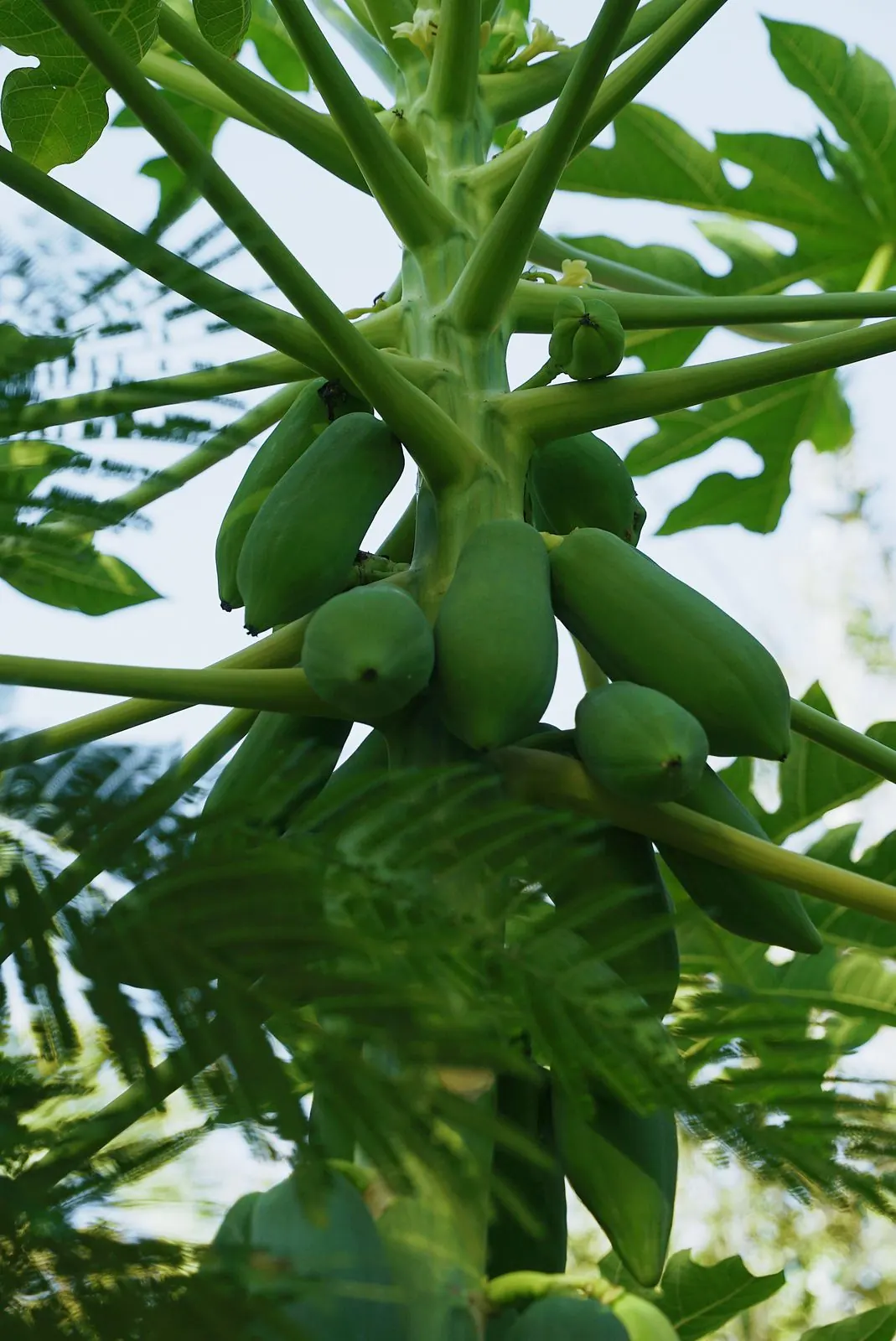 Green papayas filling in under the leaf canopy.
Red Lady and Maradol are the two we plant most in our own food forest. Some of our plants get pretty tall, so stay on top of harvesting before the fruit climbs out of reach.
Quick comparison
| Variety | Fruit size | Plant habit | Ringspot | Best for |
|---|
| Red Lady | Medium | Shorter, fruits low | Often described as tolerant | First-time growers |
| Tainung | Medium to large | Taller | Monitor and replace | Bigger fruit |
| Maradol | Large | Moderate | More susceptible | Grocery-style papaya lovers |
Papaya ringspot virus: what it is and how to live with it
Papaya ringspot virus (PRSV) is the main reason Florida papayas don't live forever. Aphids spread it as they move from plant to plant, so it's hard to keep out completely.
Signs to watch for:
- Yellow, mottled or crinkled leaves, especially new growth
- Dark green rings or spots on the fruit
- Oily-looking streaks on the stem and leaf stalks
- Slowing growth and smaller fruit
What to do:
- There's no spray that cures it. Pull and remove infected plants promptly so they don't serve as a source for others.
- Keep a young replacement coming. Start a new seedling every year or so, in a different spot, so you always have one in production.
- Start with a variety described as tolerant (like Red Lady) if ringspot has been a problem in your area.
- Keep the plant otherwise healthy: good drainage, mulch and steady feeding help it keep producing.
For deeper diagnostics, your county UF/IFAS Extension office is the best local resource.
When to plant papaya in Florida (and when not to)
Papaya is cold-sensitive. Frost can damage it and a hard freeze can kill it to the ground.
- North of Fort Myers (Tampa Bay, Sarasota, Bradenton): don't plant new papayas from mid-December through January. Wait until the freeze risk passes, usually late February into spring, so the plant has a full warm season to establish before next winter.
- Fort Myers south to Naples and Miami: warmer winters give you more room, but spring is still the easiest start.
- Already have one in the ground? On freeze nights, cover it to the ground with frost cloth and keep the soil moist. Our guide to when to plant fruit trees in Southwest Florida covers the seasonal timing in more detail.
How to plant papaya so it actually thrives
1. Give it drainage. Papaya roots rot quickly in standing water. Plant on a raised mound or berm, especially in low spots. If your yard holds water after summer storms, read building a food forest on flood-prone land.
2. Feed the sand. Papaya is a heavy feeder that grows fast. Mix in compost and keep a thick layer of mulch (pulled back from the trunk). Here's how we turn Florida sand into living soil.
3. Plant extras, then thin. Papaya plants can be female, male or hermaphrodite (both). Hermaphrodite plants set the classic elongated fruit on their own. Seed from Red Lady and similar hybrids typically gives hermaphrodite and female plants. Plant two or three seedlings per spot, then keep the strongest hermaphrodite once they flower.
4. Full sun, wind in mind. Papaya wants full sun. It's top-heavy and shallow-rooted, so it can blow over in storms. That's fine in a food forest: papayas grow back very easily and are simple to start from seed, so it's a quick, replaceable plant tucked in among sturdier trees. See hurricane-resistant food forests.
5. Plant beside your long-term trees. Papayas fit well between young mango, avocado or citrus. When the main tree starts to need the space, let the papaya go.
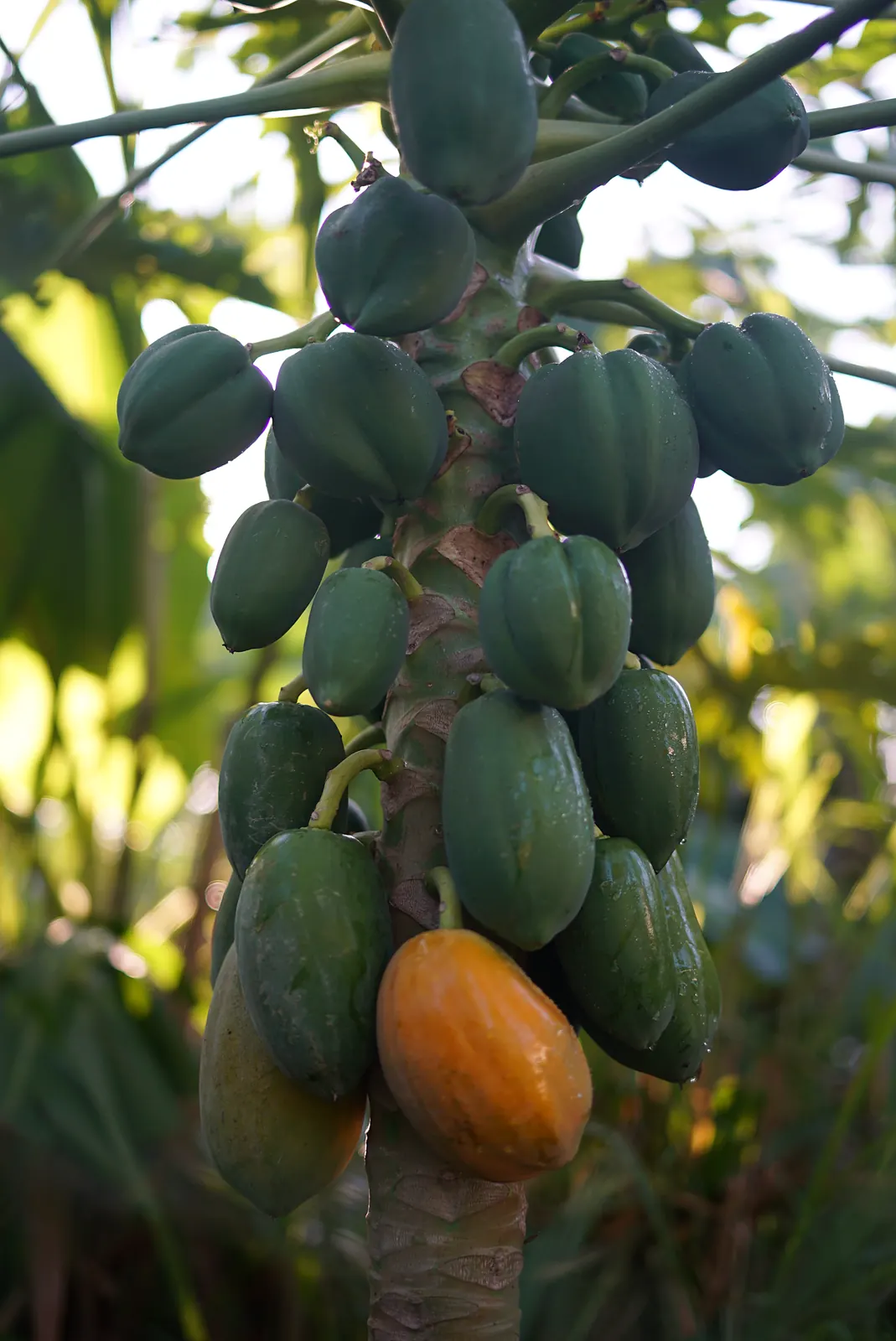 A trunk stacked with fruit in the Bradenton food forest.
Harvesting papaya
Papaya gives you two harvests from the same fruit. Picked green, it's a starchy vegetable: our family cooks green papaya in soups and other Filipino dishes. Once the skin starts turning yellow, orange or pink, it's on its way to sweet. If squirrels are a problem, pick it about halfway colored and let it finish ripening on the counter. If they aren't, let it ripen right on the plant. Many growers also slip a paper bag over young fruit to protect it from papaya fruit fly.
Ripe papaya is absolutely delicious. We eat it straight up raw, dice and freeze it, and blend it into smoothies.
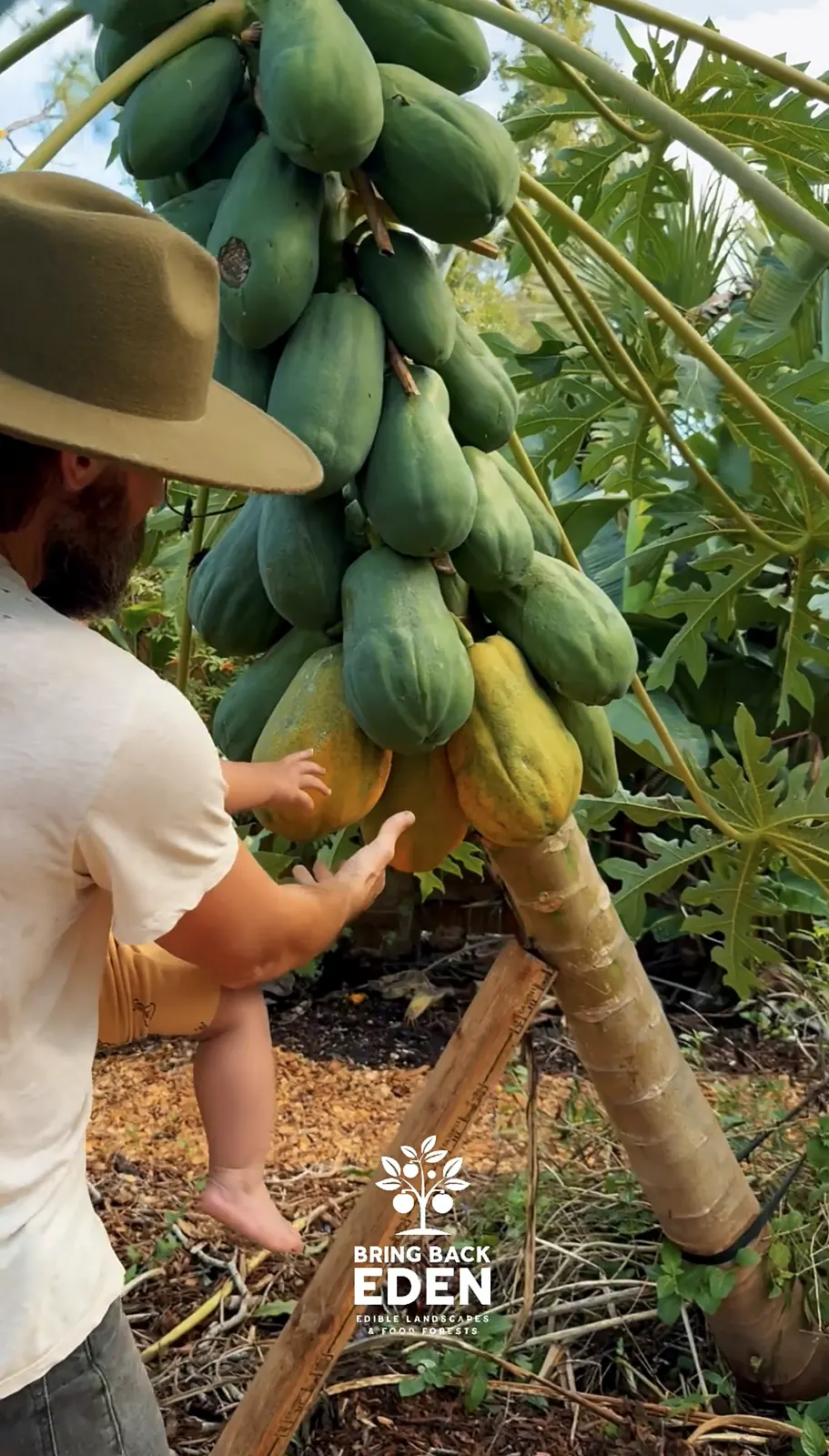 Picking papayas together in our own backyard.
Papaya for health: what's known (and what isn't)
People have used papaya for health far longer than any of us have been planting food forests, and a good part of that tradition holds up. Here's what the research does and doesn't say. This is general information, not medical advice: talk with your doctor before using any food or plant as a treatment.
Nutrition. One small papaya (about 157 g) has roughly 95 mg of vitamin C, more than a day's worth for most adults, plus potassium, fiber and beta-carotene, which the body turns into vitamin A (Cleveland Clinic). The fruit also carries folate, vitamin E and magnesium (Leitão et al., Foods, 2022).
Digestion. Papaya contains papain, a natural enzyme that breaks down protein (the same enzyme used in meat tenderizers). Papaya and its enzymes have a long traditional use for digestive complaints (Leitão et al., 2022).
Seeds as a parasite cleanse. Papaya seeds are a traditional parasite remedy in many tropical cultures. A small 2007 pilot study of 60 Nigerian children found that dried papaya seeds taken with honey cleared intestinal parasites from the stool of most of the children, far more often than honey alone (Okeniyi et al., Journal of Medicinal Food, 2007). Reviewers point out the evidence is still limited to small studies, mostly on roundworms, and that the seeds are best eaten in small amounts (Science Feedback, 2022; Cleveland Clinic). If you suspect parasites, see a provider.
Leaf teas. Papaya leaf is brewed as a tea in folk medicine across the tropics, and researchers are studying the leaf in the lab.
Cancer research. Compounds in papaya (carotenoids, phenolic compounds and glucosinolates) are being studied for anticancer activity. So far that work is in lab and animal studies, not human trials (Leitão et al., 2022). Papaya is a nourishing food, not a cure.
Cautions. Unripe papaya is rich in latex, so anyone with a latex allergy should be careful with it. Papaya can also interact with blood thinners and some other medications (Cleveland Clinic).
Sources: Cleveland Clinic, "6 Reasons To Eat More Papaya" (2025) · Cleveland Clinic, "Can Papaya Seeds Be Used for a Parasite Cleanse?" (2021) · Okeniyi JAO et al., "Effectiveness of dried Carica papaya seeds against human intestinal parasitosis: a pilot study," Journal of Medicinal Food 10(1):194–196 (2007) · Leitão M et al., "Benefits of Fermented Papaya in Human Health," Foods 11(4):563 (2022) · Science Feedback (2022).
Common questions
What is the best papaya variety for Florida?
For most backyards, Red Lady is the easiest start: shorter plant, fruit low on the trunk, and often described as tolerant to papaya ringspot. Tainung is a good pick for bigger fruit, and Maradol for the large grocery-style papaya.
How long does papaya take to fruit in Florida?
In warm conditions, a healthy plant often fruits in about its first year. Cold winters north of Fort Myers can slow that.
Can I grow papaya from grocery store seeds?
You can, and the seeds sprout easily. But many store papayas are hybrids, so the plant may not match the fruit you bought. Buying seed or seedlings of a named variety gives you a more predictable result.
Why are my papaya leaves yellow and mottled?
It could be papaya ringspot virus, especially if you also see rings on the fruit or oily streaks on the stem. It can also be cold damage, nutrient deficiency or wet roots. If ringspot is likely, remove the plant and start a new one elsewhere.
How long does a papaya plant live?
Papaya is short-lived. In Florida, plan on replacing plants every few years, sooner if ringspot shows up.
When should I plant papaya in Tampa Bay or Sarasota?
After the freeze risk passes, usually late February into spring. Avoid planting new papayas from mid-December through January.
Want papaya in a plan that actually works together?
Papaya is one piece of the puzzle. We design Florida food forests where fast fruiters like papaya and banana feed your family while slower trees grow in around them.