Short answer: support plants are the fast, cheap, generous plants you put between your fruit trees. They feed you in the first year while the mango and avocado are still small, they shade and feed the soil, and most of them end up chopped and dropped as mulch. A young food forest without them is just a widely spaced orchard with a lot of bare ground in between.
The gap nobody plans for
Here is the problem with planting a food forest. The trees you most want, mango, avocado, jackfruit, lychee, generally take a few years before they give you anything. Meanwhile you are looking at small trees, a lot of mulch and empty space, and the most common reaction is to lose interest.
Support plants close that gap. They are the layer that makes year one and year two worth walking out into, and they are doing real work underground the whole time.
Four jobs a support plant does
- Feeds you fast. Something to pick while the slow trees mature.
- Feeds the soil. Fast, soft growth you cut and drop in place, which is how organic matter gets built in sand.
- Shelters. Shade on young trunks, a break from the wind, and ground cover that stops the sun from cooking bare soil.
- Brings in the insects. Flowers all season so pollinators and predatory insects are already living there when your trees start setting fruit.
A good support plant does at least two of those at once. The best ones do all four.
The fast fruiters
These are the ones that put food on the table in the first year or so.
- Papaya. The fastest real fruit you can plant in Florida and the one that convinces people this works. Short-lived, so keep starting new ones.
- Banana. Fruit, biomass and a windbreak in one plant. Each stalk fruits once, then gets chopped around the pups. See the banana varieties we plant.
- Mulberry. Fast, forgiving, fruits early, and takes hard pruning, which means it doubles as a chop-and-drop plant.
- Barbados cherry. A compact shrub that often fruits in its first year and keeps going through the warm months.
- Strawberry tree (Panama berry, Jamaican cherry). Quick, sweet little fruit, and it throws shade over young plantings faster than almost anything.
- Pineapple. Tucks into the edges and mulch where nothing else fits. Free if you root the top off one from the store.
- Cassava, sweet potato and sugarcane. Staples rather than snacks. Sweet potato doubles as living ground cover, and cassava and sugarcane both give you serious biomass when you cut them.
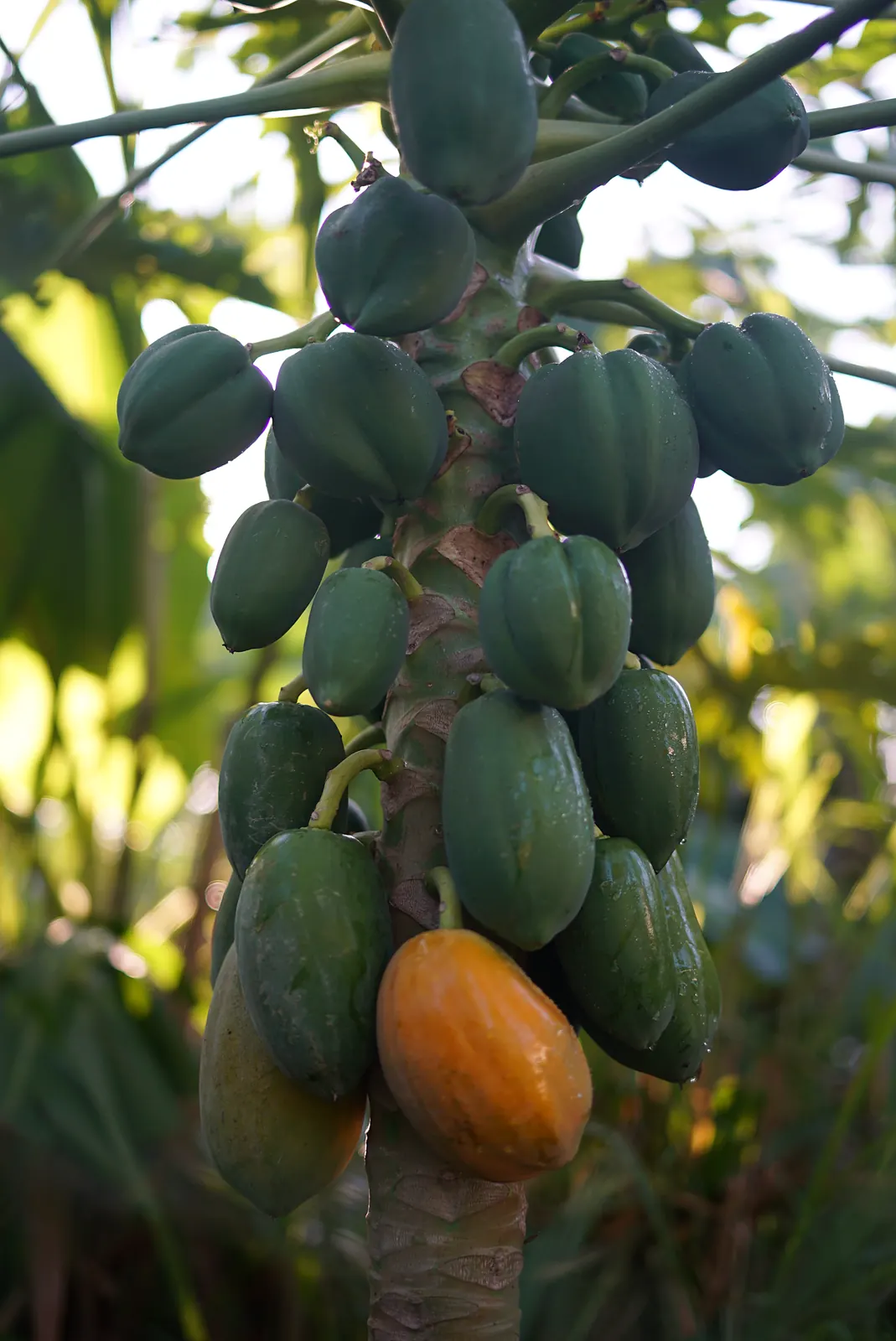 Papaya, a year or so from planting, while the slower trees around it are still filling out.
The soil builders
These are grown to be cut. You are farming biomass, not fruit.
- Pigeon pea. The one we use most. It fixes nitrogen, grows quickly from seed, produces edible peas, takes repeated cutting and is short-lived by design, so it bows out as the canopy closes.
- Lemongrass. A clumping grass that produces a surprising volume of cuttings, holds a bed edge, and goes in the kitchen. Cut it back hard two or three times a year.
- Moringa. Extremely fast, with edible leaves. Treat it as a cut-back plant rather than letting it run up into a tall, brittle tree.
- Mexican sunflower (tithonia). One of the great chop-and-drop plants, with flowers that pollinators work constantly. It spreads enthusiastically, so give it an edge you are willing to keep cutting.
- Sugarcane. Food, screening and a lot of leaf matter in one plant.
The point of all of it is the same thing we wrote about in turning Florida sand into living soil: organic matter has to come from somewhere, and growing it on site beats hauling it in.
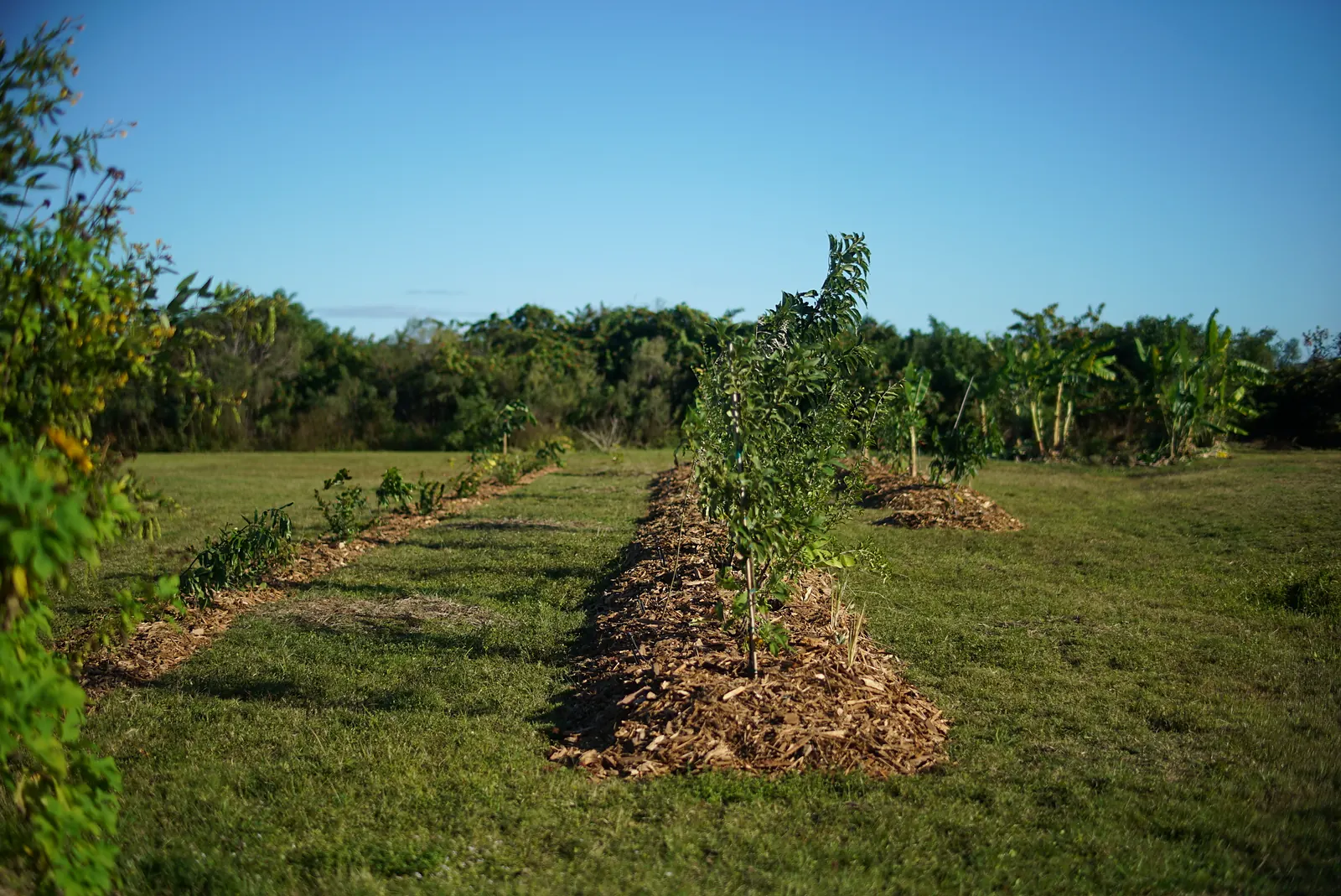 A syntropic row on the Sarasota project. Support planting between the young trees is what keeps ground like this from staying bare.
What you are looking at: syntropic rows
The rows in these photos are a syntropic system, which is support planting taken to its logical end. Instead of trees with gaps between them, everything goes in at once and very densely, stacked in layers from ground cover up to canopy, in rows with mown alleys between. Then it gets cut back hard on a schedule, and every bit of that cut material stays on the row.
It looks chaotic for the first year and then it starts to look deliberate. The density is the engine: more plants means more roots, more leaf litter and more shade on the soil, which is exactly what sand needs. Our Sarasota project is the clearest example we have, built from bare, flood-prone ground.
Watch: the full Sarasota build, from soil building to syntropic rows · More on our YouTube channel
 Watch: what the soil is doing
How to actually use them
- Plant them at the same time as the trees, not later. They are the reason the first two years feel alive. Putting them in afterwards misses the point.
- Plant dense. Closer than feels sensible. You are going to remove most of them anyway, and dense planting shades the soil and fills it with roots.
- Cut and drop, two or three times a year. Take the soft growth back hard and leave every bit of it on the ground around the fruit trees. Do not bag it, do not haul it off.
- Thin as the canopy closes. When a mango starts reaching, the pigeon peas and papayas beside it have done their job. Take them out, and let them break down where they fall.
That last step is the one people resist, and it is what separates a food forest from a thicket. Support plants are scaffolding. You are supposed to take the scaffolding down.
Timing and cold
Most of these are warm-season plants, and several, papaya and moringa especially, are genuinely cold-sensitive. North of Fort Myers we do not plant cold-sensitive tropicals from mid-December through the end of January. Winter is for planning and for getting beds ready; spring is when this goes in the ground. More on that in when to plant fruit trees in Southwest Florida.
Expect losses, and do not take them personally. Papaya is short-lived, pigeon pea is short-lived, and a hard winter will knock some of it back. That is the design working as intended, not failing.
Common questions
What is a support plant in a food forest?
A support plant is a fast-growing plant placed between fruit trees to produce food quickly, build soil through chop-and-drop, shelter young trees and attract pollinators. Most are temporary and get thinned out as the canopy closes.
What are the best support plants for a Florida food forest?
Pigeon pea, lemongrass, moringa, Mexican sunflower and sugarcane for soil and biomass, and papaya, banana, mulberry, Barbados cherry, cassava and sweet potato for fast food.
What does chop-and-drop mean?
Chop-and-drop means cutting back fast-growing plants and leaving the cuttings on the ground as mulch instead of hauling them away. The material breaks down in place and builds organic matter in the soil.
When do I remove support plants?
Thin them as your fruit trees fill out and start competing for light, usually over the first few years. Cut them at the base and leave the material on the ground.
Do support plants compete with my fruit trees?
They can if you leave them too long, which is why thinning matters. Managed properly they shade soil, add organic matter and improve conditions for the trees more than they take.
Cold-tolerance and planting guidance in this article follows UF/IFAS Extension recommendations for Florida dooryard fruit.