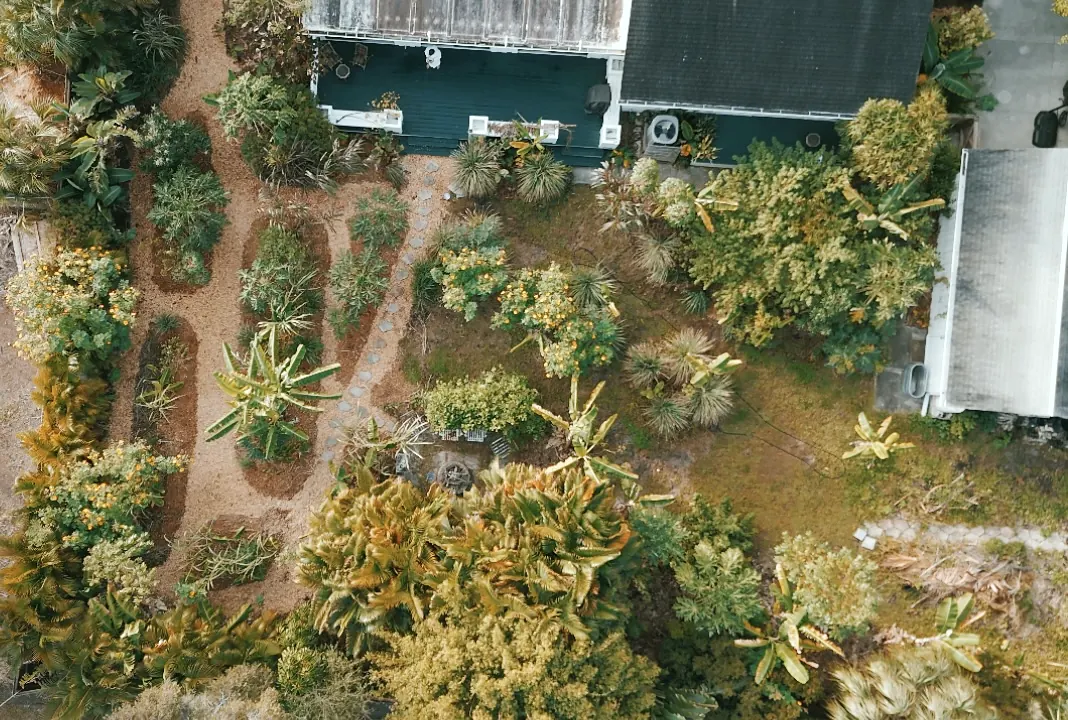
Aerial view of a mature Bradenton, Florida backyard food forest with a lagoon, firepit and shade sail, September 2026

Case study 002 · Home demonstration — Bradenton, Florida

A food forest built to be lived in

Four years of building soil, growing tropical fruit, learning from storms and turning an exposed Florida backyard into a working family ecosystem.

Location
Bradenton
Florida
Case-study area
~¼ acre
Backyard only
Transformation
2023–now
Early experiments in 2022
Project type
Home demo
Residential food forest
Focus
Food + family
Soil · Resilience · Water harvesting

The starting condition

Where we learned to build differently

Could an ordinary residential yard become something closer to Eden: a perennial landscape that feeds people, builds soil and becomes more alive over time? We wanted our children to grow up around food, soil, trees, harvests and the rhythms of a living landscape.

Sun

Open, hot and exposed, with little useful shade

Soil

Mostly sand with very little organic matter

Irrigation

Broken

Water

Parts of the yard held water in ways we didn't yet understand

Plan

No complete design at the start. Some young trees went straight into poor sand.

The evolution · Documented

From open yard to living system

Tap a year to walk through the property, from bare sand to a living system.

Family sanctuary

A lagoon, mature shade, gathering areas and fruit coming from every layer.

Aerial view of a lush Bradenton food forest wrapped around a lagoon and the house, September 2026
September 2026 · The whole system from above.
Lagoon with a small waterfall, wooden deck and chair inside the food forest
2026 · The lagoon and deck.
Stone firepit and gravel gathering area surrounded by tropical food forest planting
2026 · A gathering space inside the forest.
2022

Early experimentation

Open yard, exposed sand and learning the property.

2023

Transformation begins

Mulch, garden beds, young fruit trees and fast-producing crops establish the first real system.

2024

Storm reset

Hurricane Milton damages trees and exposes weaknesses in wind protection.

2025

Cleaner + more intentional

Recovery, succession planting, syntropic rows and a more deliberate structure.

2026

Family sanctuary

Lagoon, mature shade, gathering areas and broad fruit production.

2022 → 2026 · Soil

Building the soil came first

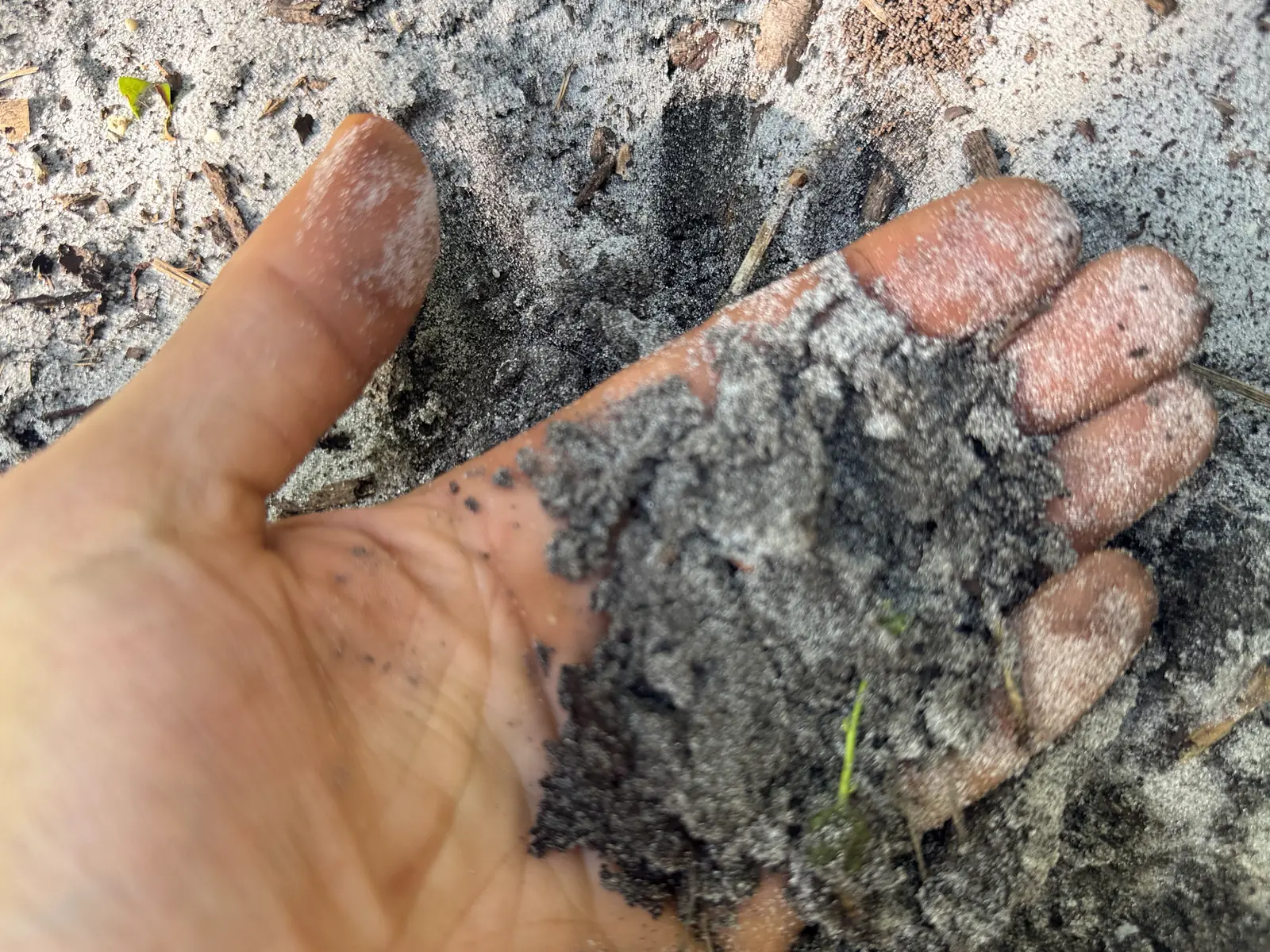
Everything above ground depends on what happens below it. Florida sand drains fast and holds almost nothing, so we spent four years feeding it: compost, deep mulch, chop-and-drop biomass and roots from dense planting.

Organic matter is what lets the system hold water through dry spells, feed fruit trees and keep soil life alive. Here's the same ground in 2022 and 2026.

Handful of pale, sandy Bradenton soil with almost no organic matter, 2022
2022 · Sand. Grey, loose and lifeless.
Handful of dark, rich composted soil full of roots and organic matter, 2026
2026 · Living soil. Dark, composted and full of roots.
Papaya trunk stacked with green and ripening fruit in the Bradenton food forest
Fast producers. Papayas extended the early harvest while longer-term fruit trees matured.

2023–2024 · Succession

Harvest while the forest grows

Mangoes, avocados, lychees, loquats, pomegranates and soursop take years to produce. Faster crops fed the family, made shade and built organic matter while that permanent structure grew in behind them.

Cassava and sweet potatoes were among the strongest first-year crops: about 150 pounds of sweet potatoes across multiple varieties and 100 pounds of cassava, with one root just over six feet long. Part of that biomass stayed in the system to keep building soil.

Feed the family now

Banana · papaya · Panama berry · sweet potato · sugarcane · ginger · turmeric · biomass grasses

Grow the canopy

Mango · avocado · lychee · loquat · pomegranate · soursop and other tropical fruit trees

Hurricane Milton storm damage to young fruit trees in a Bradenton backyard, 2024
2024. Hurricane Milton flattened parts of the young system.

2024 · Stress test

Then the storms came

In 2024, major storms, including Hurricane Milton, tested the system. Trees went over. Papayas and bananas were damaged. Starfruit, black sapote and mango trees had to be reset. Long-term trees in exposed areas suffered where wind protection wasn't established yet.

Much of the system recovered. Bananas and papayas came back quickly; other trees were reset. Resilience doesn't mean every plant stays untouched.

Early 2026 brought a significant freeze. With dense vegetation left standing around sensitive plants, the backyard came through without major losses. That doesn't make it freeze-proof.

Bananas and flowering plants growing around the edge of the water-harvesting lagoon
2026. The lagoon added water harvesting, aquatic planting and a new garden room.

2026 · Water + family

A food forest we actually live in

In 2026 a lagoon and water-harvesting feature went in, with aquatic and productive planting around it. The original yard was too hot to use for much of the year, so shade became part of the strategy. Paths now loop through the planting, harvests sit within reach, and gathering areas give the family places to sit, eat and spend time outside.

A food forest should feed the family while helping the next generation build a relationship with the natural world.

Stone firepit gathering area inside the Bradenton food forestStepping stones winding through dense tropical plantingShaded patio seating framed by palms and tropical leavesStone path through tall grasses and bananas in the food forestShaded mulched path under banana leaves

From above · December 2025 → September 2026

Nine months from the air

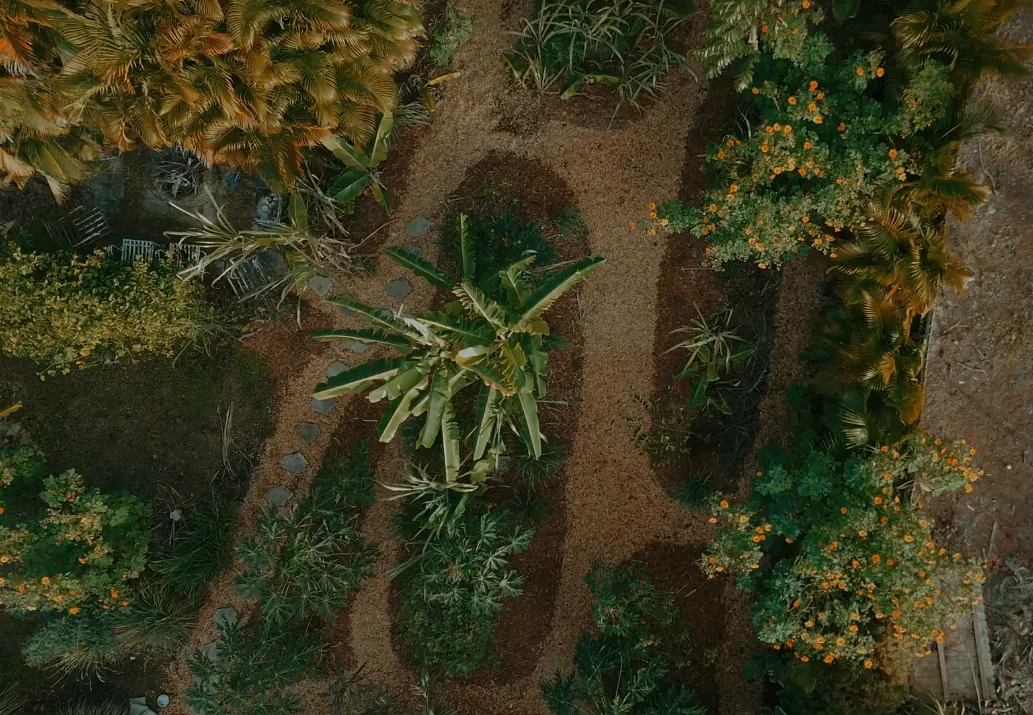
In December 2025 the rows and paths were still visible from above. By September 2026 the canopy had closed over most of the yard.

Aerial of open syntropic rows and paths in a Bradenton backyard, December 2025
December 2025 · Rows and paths still visible.
Aerial close-up of the lagoon, shade sail and firepit surrounded by food forest, September 2026
September 2026 · Lagoon, firepit and shade sail.
Aerial view of a closed tropical canopy over the Bradenton food forest, September 2026
September 2026 · The canopy closes over the yard.

The harvest · Focal point

A backyard that feeds a family

Mangoes, pomegranates, jackfruit, sugar apple, sugarcane, peaches, Panama berries, mulberries, lychee and many more, picked steps from the kitchen.

8

banana varieties

3

papaya varieties

20+

fruits and crops producing

Canvas bag full of ripe red and yellow mangoes from the Bradenton food forest
Mangoes, straight into the bag.
Matthew Nadu holding a large hand of ripe bananas from the backyard
One hand of bananas from one of 8 varieties.
Wheelbarrow full of green and ripening papayas with a dragon fruit
A wheelbarrow of papayas and a dragon fruit.
Hand holding a pomegranate, an avocado and a citrus fruit picked from the food forest
Pomegranate, avocado and citrus in one hand.
Green mangoes hanging from a young mango tree
Mangoes sizing up on the tree.
Red pineapple fruit forming in a bed of mulch
Pineapple forming in the understory.
Picking papayas from a tall papaya trunk heavy with fruit
Picking from a loaded papaya.
Bunch of green bananas growing under broad banana leaves
Bananas under the canopy.

Room to play and learn

A landscape built for childhood

We designed this yard for our children as much as for the fruit. Stepping-stone paths make it a place to explore, the lagoon brings wildlife close, and fruit within reach means kids can pick their own snacks.

There's room for kids to help plant, dig and harvest, so the garden becomes a classroom without walls: seasons, soil life, pollinators and where food really comes from.

Bring this to your school or group: Food Forest Workshops
Stepping-stone path where children explore the food forest
Stepping stones to explore.
Lagoon deck at the edge of the water inside the food forest
The lagoon: a wildlife classroom.

2026 · Producing now

The forest starts paying back

  • Mango
  • Lychee
  • Starfruit
  • Sugar apple
  • Jackfruit
  • Mulberry
  • Avocado
  • Loquat
  • Pomegranate
  • Fig
  • Citrus
  • Banana · 8 varieties
  • Papaya · 3 varieties
  • Panama berry
  • Dragon fruit
  • Peach
  • Barbados cherry
  • Monstera
  • Pineapple
  • Grapes
  • Sugarcane
  • Cassava
  • Sweet potato

Mangoes include Sweet Tart, Pickering, Fruit Punch, Philippine, Nam Doc Mai, Lemon Zest, Carrie and others. Avocados include Florida-adapted selections such as Brogdon, Hass and Choquette. Soursop and some other long-term trees are still developing.

2023

First wave

Banana · Papaya · Fig · Pomegranate · Cassava · Sweet potato

2024

Second wave

Citrus · Loquat · Sugarcane · Pineapple · Grapes

2025

Third wave

Peach · Mango

2026

The canopy matures

The remaining listed crops began producing as the longer-term fruit-tree system matured.

What this property taught us · Founder commentary

Seven lessons that shape every project

01 · Design before you plant

We spent years correcting decisions that could have been solved on paper first.

02 · Build soil first

Soil preparation now sits near the start of our process, not the end.

03 · Design for Florida

Wind, heat, heavy rain and occasional cold. Arrange for the conditions the site will actually get.

04 · Use succession

Fast producers give food, shade and biomass while long-term trees mature.

05 · Change the system when needed

Move it. Remove it. Reset the area. A living landscape is allowed to evolve.

06 · Make room for people

The best food forest is the one the family actually walks through, harvests from and uses.

07 · Make the landscape part of childhood

A productive landscape creates daily experiences with food, plants, seasons, wildlife and soil.

Stewardship

The work doesn't disappear

An established food forest isn't maintenance-free. It's maintained differently: harvesting, pruning, chop-and-drop, mulching and seasonal resets. If a dense food forest is ignored long enough, it will remind you.

Field note · Matthew Nadu

“It isn't a showroom. It's where we test ideas before bringing them into someone else's landscape.”

Plant it. Preach it. Eat it.

Want to build your own?

Sun, soil, water, wind, space and the way your family wants to use the land all shape what should happen next.

Shared as “Home Demonstration — Bradenton, Florida.” Address and household details are kept private.